As I think most people with an interest know, but perhaps
fewer understand the DCO process is “front loaded”. This doesn’t actually mean
to put the load in the front like a wheelbarrow, but in this context; it means
to arrange or plan a project, or process, so that a large portion of activity
occurs in an early period.

The idea being that the people wanting to get the government
to accept a DCO, in this case RiverOak, engage with the people who are for,
against or just interested in the project, look for the snags and pitfalls and
find solutions prior to making an official submission to the DFT.
I don’t think it matters that much if you are for or against
building an airfreight hub at Manston, in fact I would say that if you are for
it, now is the right time to play devil’s advocate.
The DFT are very good at replying quickly and informatively
to correspondence and because the legislation relating to DCOs insists that it
is an open and transparent process the DFT are very good at publishing
information about the correspondence they get on their website at https://infrastructure.planninginspectorate.gov.uk/projects/south-east/manston-airport/
RiverOak on the other hand are not, their last press release
is now a moth old, none of the correspondence and responses to their informal
consultation have been published on their website. In fact to me it appears
that they are out-to-lunch. Perhaps they have bigger fish to fry and will get
around to Manston eventually, or perhaps they have all gone on holiday.

Anyway about a week ago I wrote to them a preliminary email,
see http://thanetonline.blogspot.co.uk/2016/08/manston-airport-dco-update-and-reason.html
ccd it to the DFT, got a response from the DFT but haven’t heard anything from
RiverOak apart from an automated response, impying they are out-to-lunch.
Time is getting on with respect to the deadline for their
unofficial consultation, which is – as far as I understand – the centre for
front loaded dialogue, so I have roughed out another email for them, see below.
Before I send it off I am asking on my blog and on such
related Facebook Groups what readers think, I will also send it off to the DFT
before sending it to RiverOak, this is to make sure that I should be putting my
questions to RiverOak.
Anyway, here it is:-
Hi at RiverOak (at the moment I am a bit confused about who
to write to there)
With respect to the questions already I have put to RiverOak
in my email 10.08.2016 I initially sent it to George Yerrall, partly because he
appears as RiverOak’s Chief Investment Officer on both RiverOak websites http://www.riveroakinvestments.co.uk/
and http://www.riveroakic.com/ and
partly because he was the first member of RiverOak to respond to me when I
initially emailed them.
I got an automatic response to my email 10.08.2016
“ -----Original
Message-----
From: George Yerrall <****@riveroakic.com>
To: michaelchild
Sent: Wed, 10 Aug 2016 10:08
Subject: Automatic reply: Manston DCO
I am currently out of the office and will only have
intermmittent access to email and to phone service. “
I assume he must be on holiday. So I forwarded the email to
Stephen Denardo, who also appears on both website as CEO and a partner.
As I have had no response or acknowledgement from RiverOak,
apart from the out of office, I have no way of knowing if they received my
email or intend to reply to it prior to the deadline date of their initial
consultation 05.09.2016.
As the CPO process is front loaded and I had hoped to enter
into a meaningful dialogue with RiverOak, regarding the aspects of the project
that concern me, as I feel that I can give some useful input about at this
stage. I am starting this process without a reliable point of contact at
RiverOak, so I am sending this information to you in the first instance and I
hope you will be able to tell me if it is appropriate for me to then send it to
RiverOak.
As a local businessperson and resident there are two aspects
to the development of Manston that most concern me.
One being the economic growth and the resultant benefits to
my own business.
The other being the pollution generated by any commercial
development on the site and the aspects of this detrimental to the local
businesses and community.
I have skimmed through the scooping report and other
documents now published at https://infrastructure.planninginspectorate.gov.uk/projects/south-east/manston-airport/
and there are aspects of the environmental strategy about which I would like
further clarification prior to completing the informal consultation.
First my initial questions about noise pollution.
My understanding is that the minimum activity generated by
the airfreight hub would be 10,000 airfreight movements a year which equates to
approximately 200 movements per week or approximately 30 movements in a 24 hour
period.
I am assuming that there is also an optimal amount of
freight movements per year, the scooping documents seems to indicate 20,000 per
year, there would also presumably be a maximum figure envisaged, although I
can’t find it.
Could you please clarify the optimal and maximum number of
freight flights?
With respect to night time activity I can only find what
appears a maximum of 18 movements per night, with night time being defined as
after 23.00 and before 7.00.
Obviously there is a great deal of information where noise
measurement in dB is given, but for a layman this is difficult to interpret and
would presumably depend on the sound insulation of the building you were
sleeping in and the sound reflecting qualities of the surrounding
infrastructure.
Could you please clarify the maximum number of freight aircraft night movements?
I am assuming that the aircraft type will be mostly the same
as the previous Manston freight activity i.e. 747 series, can you please
confirm this?
Can you please clarify how the number of flights, and night
flights – detailed separately, relates to the number of people employed,
directly and indirectly?
The town most affected by noise pollution will be Ramsgate
as it is at the end of the runway, and this pollution can be divided in to
daytime noise, mostly affecting production in local business, educational
advancement in local schools, the local tourist industry and night time
pollution which has roughly similar effects but is generally more damaging.
Ramsgate has nearly 900 listed buildings (one of the highest
numbers for any uk town) and a considerable number of other buildings within
the Ramsgate conservation area, residences, businesses schools and collages.
This includes a number of language collages, which are significant contributors
to the local economy.
Under normal circumstances the main mitigation for noise
pollution is sound insulation, however with many listed buildings and buildings
in conservation areas, effective sound insulation is expensive, difficult and
sometimes impossible.
Please can you explain how you have addressed the problem of
noise insulation as related to Ramsgate’s large number of listed buildings?
My first initial questions about air pollution.
As you are no doubt aware Thanet has good air quality apart
from some isolated areas around road junctions and the background level of
particulate air pollution that I mentioned to the environmental expert at the
Canterbury consultation session.
Inasmuch as there are likely to be people reading this who
hold administrative positions and are not conversance with particulate air
pollution, I will first make a short explanation.
Firstly particulate air pollution is a fairly newly
discovered problem, related in recent media articles to diesel cars now being a
less desirable option. Secondly that collective impacts of multiple air
pollutants interact in the atmosphere and impact on health. Thirdly particles
associated with particulate pollution are very small and bury themselves deeply
in lung tissue, causing reduced life expectancy from stroke, heart disease,
lung cancer, and chronic and acute respiratory diseases, including asthma.
Thanet is already presumed to have annual levels of PM2.5s
of 11µg/m3, which is above the World Health Organisation guidelines and around
the threshold for a measurable related reduction in life expectancy.
The nearest monitoring station is at Southend-on-sea 11µg/m3
and the other monitoring station thought likely to have similar levels is at
Eastbourne, which is also recording level of PM10s above WHO guidelines (PM10
21µg/ PM2.5s 15µg/m3)
This is thought to be due to the prevailing wind direction
across southern England combined with the proximity of the industrial areas of
Europe. PM2.5s are slow to disperse from the atmosphere.
The main sources of particulate air pollutants are Diesel
engines, fuel oil and aviation jet engine fuel, a freight aircraft (747 type)
movement, takeoff or landing burns one tonne of aviation fuel, the dispersion
distance (the distance away from the fuel burn upwind where the particulate
level returns to around the background level is around 10 miles for PM10s and
further for PM2.5s)
Obviously added to this would be the lorry movements,
considerable as Manston has no fuel pipeline.
Margate, Ramsgate and particularly Broadstairs are upwind of
Manston in terms of prevailing wind direction.
Are you planning to monitor particulate air pollution in
Thanet prior to planning the number and type of aircraft movements viable at
Manston?
Will there be any compensation scheme related to any
reduction in life expectancy and serious health due to airport generated
particulate air pollution?
Do you have any plans to mitigate the amount of particulate
air pollution and its affects in Thanet?
My first initial questions related to water pollution.
Manston sits on top of the Thanet chalk aquifer, which for
the layman means, the chalk can be seen like a large sponge, sitting on top of
clay which is impervious and surrounded by seawater which holds the freshwater
- gathered from the rain falling in Thanet - in place. Although the water moves up and down freely,
it hardly moves sideways at all.
Water is collected for the Thanet water supply by digging a
well with a side tunnel under the water level, called an adit. One such adit
runs most of the length of Manston runway, deep under the runway. Water sourced
from the Manston catchment is also drawn from agricultural boreholes and used
untreated for irrigation and food crop washing.
This means that the Manston runway can be considered as
sitting on top of one of Thanet’s essential drinking water reservoirs. Thanet's potable (drinkable) water is blend
of water from Plucks gutter (river Stour). Lord of the Manor Source
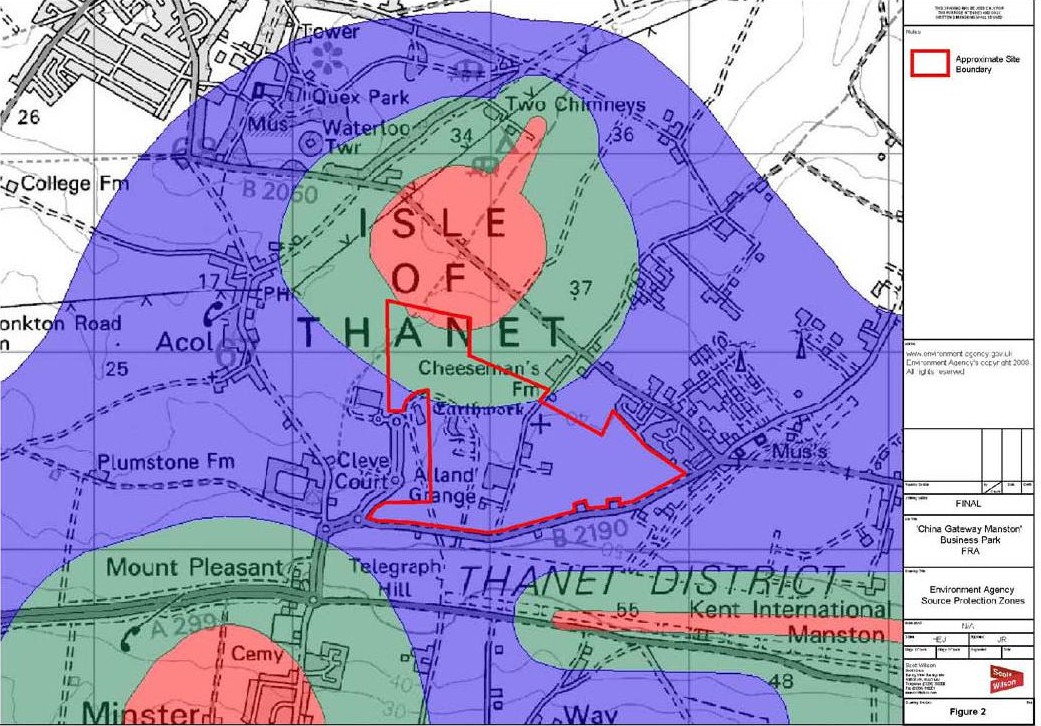
Protection Zone (SPZ) 1 and from the Wingham Well. It's all then held at
the Southern Water works near the Airport. The Source Protection Zone
(SPZ) 2 lies within the Manston site. Dilution
of potable water is becoming less and less available and more expensive,
Southern Water and the EA say the Manston aquifer is essential to maintaining
the Thanet water Supply.
Manston Runway and the majority of the hard standing was
supposed to be drained into the sea at Pegwell Bay. In practice the pipe was a
concrete sectional pipe and leaked at every join, meaning that in reality the
drainage was into the aquifer south of Manston and dispersed by the pipe.
At the consultation your environmental spokesperson assured
me that the pipe would be lined with plastic.
I would imagine a worst-case scenario would be a spillage
(of say 50,000 litres of jet engine fuel) on the grassed part of the site
caused an air crash.
Have you in the first instance examined the water source
protection safety measures taken at other airports that lie on top of essential
drinking water aquifers?
Do you have an air accident fuel spillage a strategy?
Have you factored in the air accident fuel spillage
environmental cleanup costs?





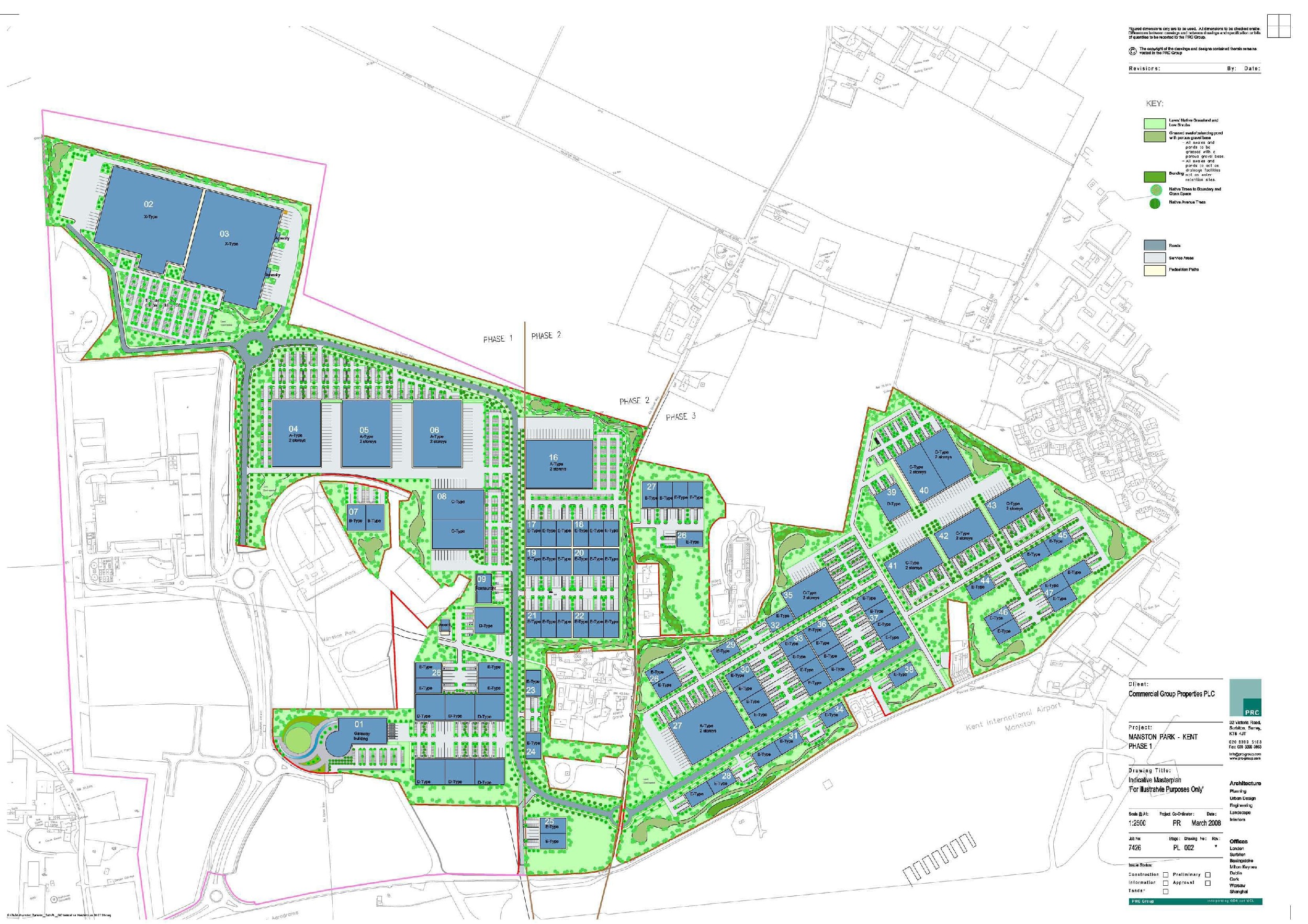


 I have just been reading the Environmental Statement for The China Gateway Manston and was interested to notice that it has been prepared by PRC Architects. These are the same chaps who produced the Pleasurama site plans that have certain unusual features