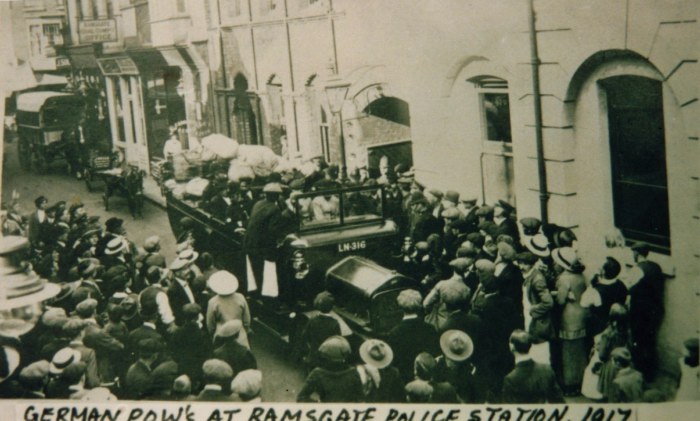
The entry from "Cockburn's Diary Ramsgate Life in the First
Word War" first:
“Monday August 3rd 1914
Surely there has never before been such a Bank Holiday as
this has proved to be. The morning papers stated that the Cabinet would meet
again this morning and that Parliament would assemble at 3.30 pm when the Prime
Minister would make a statement. During the morning no further news of any
importance was received at Ramsgate. All sorts of rumours were about, and as
the baker told us that the government had taken over the L. C. & D. (London
Chatham & Dover) Railway station. Mummie and I walked down that way in the
afternoon to see if my train would run to Westgate as usual tomorrow. The
station was open, but all the Inspector could tell me was that “as far as he
knew” the trains would run as usual tomorrow. Returning to Addington Street we
waited about in case further news should come through. All we heard however was
that Bank Holiday would be extended until Thursday, and that the British
Mediterranean fleet was reported to have cleared for action.
Directly after tea I went again to Fox's and found a notice
to the effect that the Cabinet were unable to make up their minds what to do
and the question was to be debated in the House of Commons tonight. It also
stated that Mr John Burns and Sir John Simon had left the Cabinet. This, is as
afterwards proved, was not a fair resume of what had taken place. But it served
to dishearten some of us very much, as it appeared that the Government was
hesitating when the honour of the country was at stake.
The next message half an hour or so later, was to the effect
that “ war would be declared on Germany tonight or tomorrow morning,” “Mr
Balfour and Mr Bonar Law have joined the Cabinet.” This was altered by the
substitution of Lord Lansdowne's name for that of Mr Balfour, but the whole
message subsequently proved to be incorrect.
Later in the evening Mummie and I went on to the East Cliff.
The Band and Concert Party were playing, but the crowds were not up to their
usual Bank Holiday standard, either as to size or merriment. Indeed it was
defiantly noticeable all day that a sense of anxiety and suspense weighed on
the majority of people in the town.
The public lamps on the East Cliff in front of the Coast
Guard station were extinguished, to enable the coast guards to distinguish more
readily the lights and signals from the sea. We could not see any signs of the
two gunboats which had been lying off Ramsgate all day and concluded that they
had gone, when suddenly first one then the other started flashing their
searchlights about. They had been laying there all the time with their lights
out. Presently they commenced signalling with their flash lamps from the
masthead, and suddenly 5 or 6 ships further out at sea, whose presence we had
not before suspected, commenced replying also by flash lamp. This was evidently
the French Naval Squadron, which had passed Dover late this afternoon, steaming
northwards. It was very interesting to watch, knowing that France was in for,
and we on the brink of the real thing.”
A note for children here: The Cockburn is pronounced
co-burn.
When I was a child there were quite few members of my family
and family friends who had fought in WW1 around. What they had to say
about was basically, not a lot, I was born in 1953 and most of the adults had
loads to say about WW2, from our perception as children it
seemed that the adults had enjoyed WW2 loads and we were looking forward WW3
with enthusiasm.
I was quite severely disabled as a child and my maternal
grandfather who was approximately the same age as the century, who had lied
about his age had and gone fight in WW1 when he was 15, developed diabetes with
complications which involved the amputation of one of his legs, came to die with
us.
I wasn’t really well enough to go to school; so much of the
task of looking after him fell to me. He moved into our dining room and I set
up camp on the dining room floor, so that when he woke up in the night he could
poke me with a stick and I could fetch things for him.
He didn’t have much to say about WW1, but from what he
either didn’t say or did say I developed some sort of notion of what he would
have said if I hadn’t been 13¾ but had been 15 instead, and I slowly developed
the idea that in fact WW3 wouldn’t be such a good idea, but I did start lying
about my age, which is much easier to do if you are visibly disabled.