Showing posts with label Granville Hotel Ramsgate. Show all posts

Wednesday, 17 February 2016

Another fine plot sold at auction yesterday, this time it’s the land at the back of the Granville here in Ramsgate.

Although this post is supposed to be about the red bordered bit in the map below, first a bit of a history - or is it geography - lesson. I publish two books about The Granville written by Benedict Kelly so if you really want a proper Granville history lesson here are the links http://michaelsbookshop.com/catalogue/the_granville_hotel___the_story_of_the_granville_hotel_ramsgate_1869_2012.htm and http://michaelsbookshop.com/catalogue/the_granville_hotel___revisited.htm 

One of the most distinctive buildings on Ramsgate’s cliff tops is Granville House this was designed by Edward Welby Pugin the son of Augustus Pugin and was a hotel from 1869 to 1946 after which it was converted into 48 apartments.


Various additions and modifications were made to the building during this period and all of these were done in the same gothic revival style used by Edward Welby Pugin.


During the second world war part of the building was destroyed by a bomb.


Then in 1982 another large chunk was demolished.

I suppose there is a balance here between what is most dangerous and destructive to our historic architecture the world war in the 1940s or the local council in the 1980s where a significant proportion of councillors were estate agents or involved in property development.


So looking at the map and wondering where the responsibility lies for demolishing parts of a significant listed building the green bit was down to Adolf Hitler and while the red bit down to TDC granting consent to demolish part of a listed building.

Anyway between the demolition and 2004 various planning applications to build the usual plastic windowed tacky high density flats on the site.


Then in 2004 the part demolished by Hitler was rebuilt in the same gothic revival style used by Edward Welby Pugin.

Nothing much happened after this apart from the remaining land changing hands,  getting planning permission for an ugly 80s structure and developers going bust until the site was sold by the Receivers in 2012.


The building site was bought by Jason Hough for £160,000 who submitted an application (L/TH/12/1019) in January 2013, to build 10 one-bedroomed flats and 28 two-bedroomed flats. Although recommended by the TDC case officer, Councillors voted against I guess there aren’t so many councillors who are estate agents these days.

The developers case for getting planning permission granted seems to have been if you can get it for an ugly 80s structure in the 80s why can’t you get it for an ugly 80s structure now.

I think the real point he has missed is that having demolished half a gothic revival building and then rebuilt a quarter of it in gothic revival style, the only thing that makes sense is to rebuild the remaining quarter in gothic revival style.    
Permission (ref F/TH/14/0083) was granted by Thanet District Council on 16th May 2014 for “Erection of a part 4, part 5 and part 6 storey building comprising 10 x one bedroom flats and 28 x two bedroom flats, fronting Truro Road and D’Este Road, with a raised terrace in the internal courtyard and associated car parking comprising 17 spaces.

Here are a few pictures taken from these plans, as you see they don't seem to have understood the gothic revival style. my take being gothic revival plus new build is fine but gothic revival plus new build gothic revival plus new build 1990s style isn’t it's just a mess.


Anyway it was a nice little earner from £160,000 in Jan 2014 to yesterday when it sold at auction for £480,000 this just goes to show what a planning consent can be worth.


 While we are on the subject you may be wondering about the blue bit on the map, this is the derelict bar a dinning room, links to photos of this and the inside of the tower view from the top and so on.


Sunday, 12 July 2015

Some thoughts on Roller Skating in Thanet

It’s been a bit of a roller skating weekend for me, so sitting here somewhat bruised, due to the falling over aspect I thought that I had better do my duty on the local history front.


First let me clarify what I mean by roller skating is the business done with skates that have four wheels, one in each corner, like the skates in the picture.


The first properly documented proof I have of this activity occurring in Thanet is in 1879, this picture shows the roller rink at The Granville in Ramsgate and comes from a London Illustrated News supplement about the Granville in Ramsgate, click on this link if you want to read the whole thing http://www.michaelsbookshop.com/gt/id7.htm


It would appear from the picture. What? Perhaps the skater in the picture has made the mistake I made earlier and has put his reading glasses on to read a text message and while trying to extract his smart phone from a tight pocket has just realised that not only do reading glasses make the floor appear all blurry but also make objects on said floor appear in a different place. Actually probably not.

Although Victorian women appear to be involved in roller skating, they don’t appear to actually skate, I guess that as modesty conventions of the time wouldn’t have allowed them to wear trousers or show even hosed leg above the ankle, learning to skate would have been tricky

Friday, 14 February 2014

Granville House Ramsgate another lot of plans and a bit of history

One of the most distinctive buildings on Ramsgate’s cliff tops is Granville House this was designed by Edward Welby Pugin the son of Augustus Pugin and was a hotel from 1869 to 1946 after which it was converted into 48 apartments.


Various additions and modifications were made to the building during this period and all of these were done in the same gothic revival style used by Edward Welby Pugin.


During the second world war part of the building was destroyed by a bomb.


Then in 1982 another large chunk was demolished.

I suppose there is a balance here between what is most dangerous and destructive to our historic architecture the world war in the 1940s or the local council in the 1980s where a significant proportion of councillors were estate agents or involved in property development.


So looking at the map and wondering where the responsibility lies for demolishing parts of a significant listed building the green bit was down to Adolf Hitler and while the red bit down to TDC granting consent to demolish part of a listed building.

Anyway between the demolition and 2004 various planning applications to build the usual plastic windowed tacky high density flats on the site, some were passed at planning but as often happens the money couldn’t be found and now all of the planning consents have expired.


Then in 2004 the part demolished by Hitler was rebuilt in the same gothic revival style used by Edward Welby Pugin.

Nothing much happened after this apart from the remaining land changing hands and developers going bust until the site was sold by the Receivers in 2012.


The building site was bought by Jason Hough for £160,000 who submitted an application (L/TH/12/1019) in January 2013, to build 10 one-bedroomed flats and 28 two-bedroomed flats. Although recommended by the TDC case officer, Councillors voted against I guess there aren’t so many councillors who are estate agents these days.

The developers case for getting planning permission granted seems to have been if you can get it for an ugly 80s structure in the 80s why can’t you get it for an ugly 80s structure now.

I think the real point he has missed is that having demolished half a gothic revival building and then rebuilt a quarter of it in gothic revival style, the only thing that makes sense is to rebuild the remaining quarter in gothic revival style.    

Anyway the new planning application ref is F/TH/14/0083 you have to go to the council’s planning website http://www.ukplanning.com/thanet and put it in the application ref search box to view the plans. 

Here are a few pictures taken from these plans, as you see they don't seem to have understood the gothic revival style yet, so I will be objecting to this application on the grounds that gothic revival plus new build gothic revival  is fine but gothic revival plus new build gothic revival plus new build 1990s style isn’t it's just a mess.


 While we are on the subject you may be wondering about the blue bit on the map, this is the derelict bar a dinning room which is back on the market and likely to go back into use, links to photos of this and the inside of the tower view from the top and so on.


Saturday, 20 April 2013

Four old prints of Ramsgate’s Eastcliff

 This first one is after 1860 as the Ramsgate Sands Railway Station can be seen. 


Update I have now pinned this print down exactly, it was commissioned for the book I publish: Delineations Historical and Topographical of the Isle of Thanet and the Cinque Ports by Edward Wedlake Brayley, http://www.michaelsbookshop.com/catalogue/delineations_historical_and_topographical_of_the_isle_of_thanet_and_the_cinque_p.htm the plate for the print was engraved by William Deeble in 1817 and was taken from a drawing by HENRY G. GASTINEAU (1791-1876) who was a topographer and landscape artist. He trained as an engraver and then studied at the Royal Academy Schools, after which he travelled extensively in Great Britain painting the scenery as he went. He was elected Associate to the Old Watercolour Society (AOWS) in 1821 and became a full member (OWS) in 1823. From 1827, Gastineau worked in Camberwell as a drawing master, where he died on January 17th 1876. 
 
 The square towers on the left are the outbuildings to Eastcliff Lodge, these are still there and the Italianate greenhouse is built against them. the pointed towers on the right of the print are those of Eastcliff Lodge itself. This once stood in King George VI Park, obviously it was bought by the council and demolished.  


I have added a picture of Eastcliff Lodge by JMW Turner for clarification. As far as dating the print goes Eastcliff Lodge first appears as occupied in 1803 as a summer residence of Queen Caroline, so it was probably built around 1800. 


 This next one is before 1842 when the current lighthouse was built, the old one shown in the print was too near the end and tended to knock the spars off ships entering the harbour.
Obviously it as after 1817 when The Clock House was built by Benjamen Wyatt and George Louch.
Once again after 1860, I will add to the historical notes as aspects occur to me.

Many thanks to Ben – local antiquary, author of The Story of the Granville Hotel Ramsgate 1869-2012 (see http://www.michaelsbookshop.com/catalogue/the_granville_hotel___the_story_of_the_granville_hotel_ramsgate_1869_2012.htm ) and sometime author of various historical articles in local periodicals – for sending me the prints and for enhancing the image files. 

Saturday, 16 March 2013

Granville House Ramsgate, update on the proposed development


There does seem to be some flexibility on this issue with the architects prepared to enter into a dialogue with objectors and residents of the existing building, so first this letter.

My own take on this being that once redevelopment of the bits of the Pugin and Pugin like original that was all built in Victorian gothic style have been recently rebuilt also in Victorian gothic style, then the remaining part that was demolished should now be rebuilt in Victorian gothic style.

Here are a few pictures of the recent rebuilding of the front part of the Granville.     


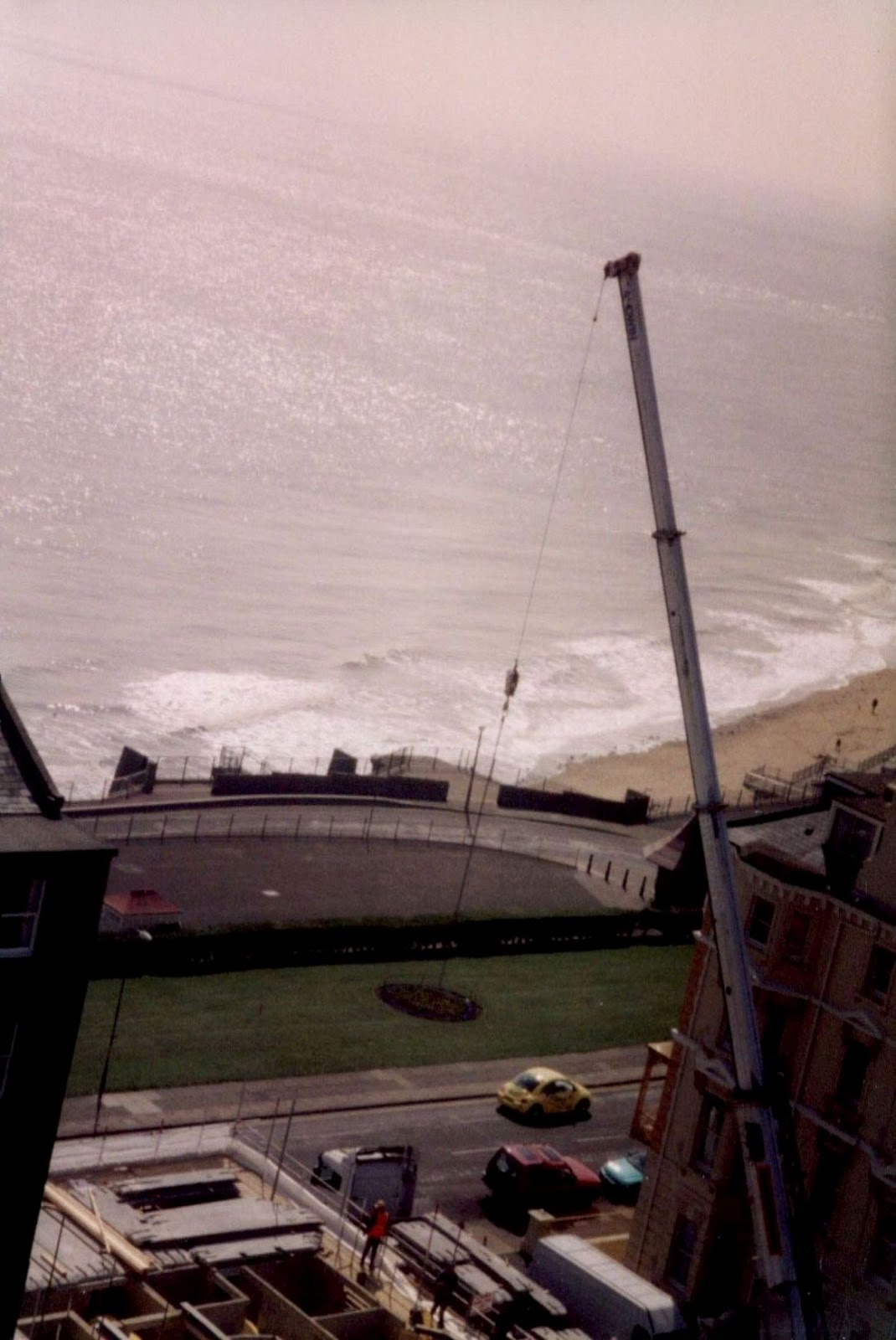
As you can see it is possible to build a modern building in this style using a mixture of traditional and modern construction techniques, the pictures should expand when clicked on compulsively.  


Front view of Granville House Ramsgate in response to comment. The new bit is the part on the left with the extra floor.