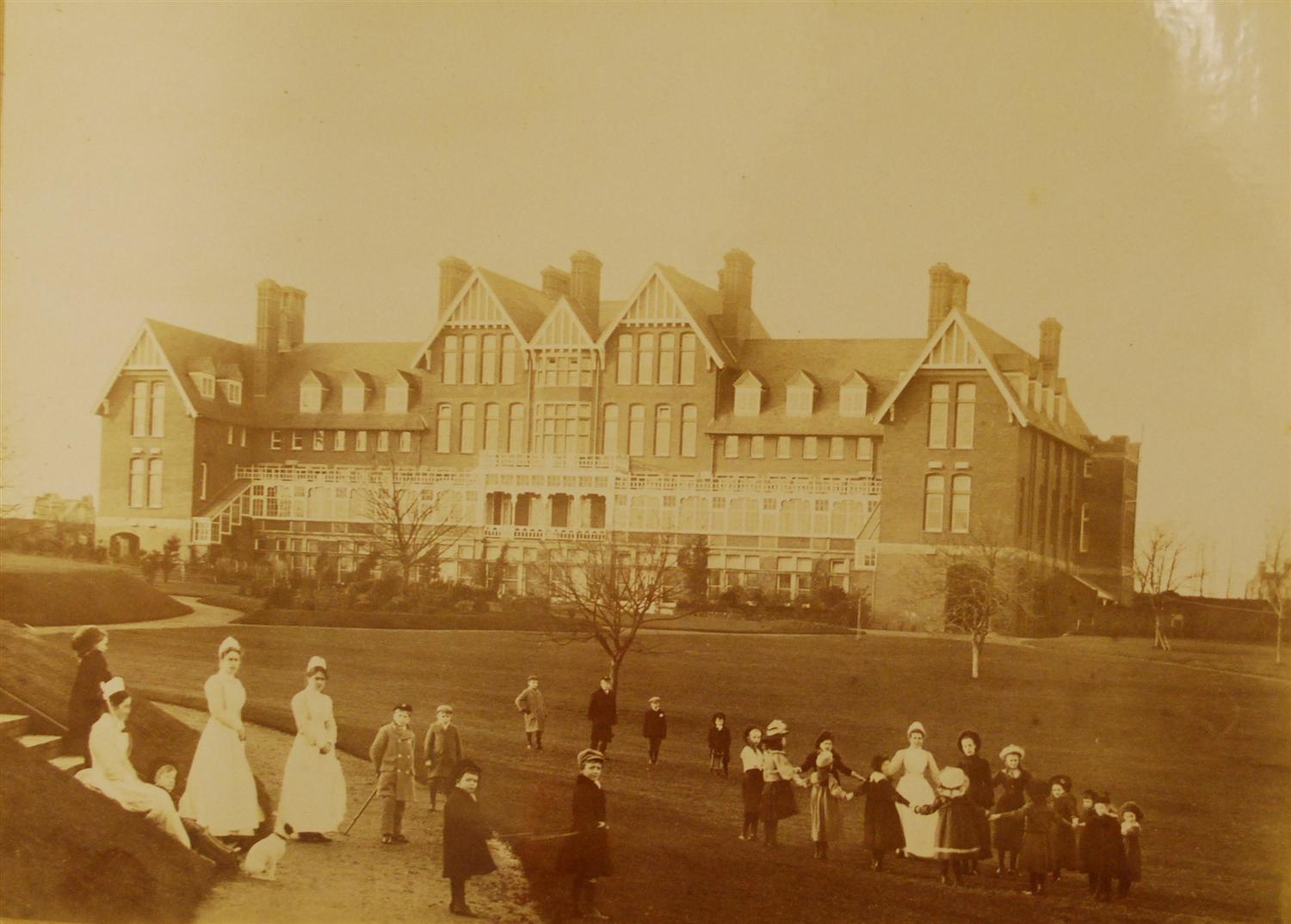
The many local convalescent homes is mainly due to historic associations between the seaside and health. From around 1730 the medical profession became interested in the sea and for a long time, more than 100 years, a course of drinking seawater, being ducked under the sea every day for months, took over from bleeding people as the cure for most ailments.
I think the children's convalescent home in the UK dates from around 1900

Alfred Fernandez Yarrow was born in 1849 in London to a Jewish father & Christian mother. He was exposed at an early age to the slums & the poor of London's East End. Alfred was educated at London University College, & apprenticed at the age of 15 to Ravenhall & Co of Stepney. Apart from marine engineering Ravenhall & Co maintained & improved agricultural machinery, steam carriages & pumping engines. By the age of 23, Alfred had raised £1,000, & went into partnership with another engineer, Mr Hedley, forming the company Yarrow & Hedley, Marine Engineers of Poplar. The company purchased a half acre yard with a Thames riverside frontage & two cottages to be used as offices. The yard set up making small steam powered river launches, making 150 of them between 1868 & 1875. In 1871, Alfred became interested in building a new type of naval craft, namely the Torpedo boat. Between 1871 & 1878, the company had manufactured 350 torpedo boats which were produced for navies throughout the world. In 1875, Alfred bout Mr Hedley out, & expanded the business buying larger premises on the Isle of Dogs.
By this time, Alfred had become a member of The Institute of Naval Architects, & a member of The Institution of Civil Engineers. Developing on from his work on torpedo boats, the company took on the task of producing a new kind of warship for the Royal Navy, resulting in H M S Havelock, the first destroyer built for the Royal Navy. This was followed by H M S Hornet in 1893, & another thirty destroyers being built over the next seven years, all from the Isle of Dogs site. Having outgrown the London premises & with further orders on the way, Alfred moved the Yarrow Company to Scotstoun on the River Clyde. He took not only the machinery with him, but transferred the majority of the workforce & their families as well.
Alfred was by now a millionaire, but never forgot his father's advice back in the East End when he was a child, “Never loose the opportunity of doing a kindness”. He treated his workers fairly, built housing for them, & introduced medical facilities at the shipyard. He also gave gifts such as £25,000 to build an Outpatients Department at The London Hospital, £20,000 to set up a hospital research fund, & £24,000 to establish a nurse's training school at Govan. His maxim in life was, “Always support, help & encourage those who were likely to succeed”.
In 1893 Alfred Yarrow set out to build a convalescent home for children. After much searching he came upon a suitable site, overlooking the sea. This was Wrotham House which sat in 10½ acres of gardens just of the Ramsgate Road, the previous seaside home of Richard Richardson, a wealthy London builder. Not knowing much about convalescent homes, Alfred spent much of 1894 with his architect, Mr Barrow Emanuel, visiting as many
Children's convalescing homes throughout the country, interviewing the Matron of each institution he visited. All the best points they found were noted, the worst points discounted. His ambition was to build the best convalescent home for children, which was to be “as perfect as possible”. Many of the homes he had visited were overcrowded & understaffed, leading to children taking longer than necessary to recover from their ailments, & even sometimes actually spreading diseases that it was intended to cure. Alfred settled on 100 children, 50 boys & 50 girls as the ideal number of children for sufficient staff to cope with, & set about designing his home accordingly. Wrotham House was unsuitable for conversion so it was pulled down to make way for the new building.
The best description of the building is in a 1901 Broadstairs Visitors Guide which is as follows. It is situated at the south end of the town, on the brow of a hill, sloping gently down to the sea. It is a noble brick edifice, enclosed in ornamental grounds, &, with its kitchen garden & orchard, covers an area of ten & a half acres. It is an elaborately appointed building, designed to accommodate 100 children, 50 boys & 50 girls, in addition to the working staff. The Home fronts the Ramsgate Road, & at the entrance gate is a handsome porter's lodge.
The building occupies a frontage of 218 feet, the depth of the wings 75 feet, & in the centre block 62 feet. The general design of the Home is a central administration block, with wings for boys & girls separately. On the upper ground floor is the main entrance to the road, & access from it is given to a special octagonal hall. The matron's
I publish a book about Broadstairs convalescent homes here is the link to it so more about this one and some of the others there. Coming to the bookshop here in Ramsgate and having a browse of the book is recommended.