

as a follow on from yesterday's post a bit of research about the Ramsgate tugs called Aid, not sure all of the info is correct particularity on Aid 2 which I couldn't find more than one online source for and nothing in books. I am fairly sure of the rest of it.
The three Ramsgate Tugboats all called Aid, actually I think tugboat may be an Americanism, but then tugs at Ramsgate is easily confused with the Dickensian Tuggs at Ramsgate.

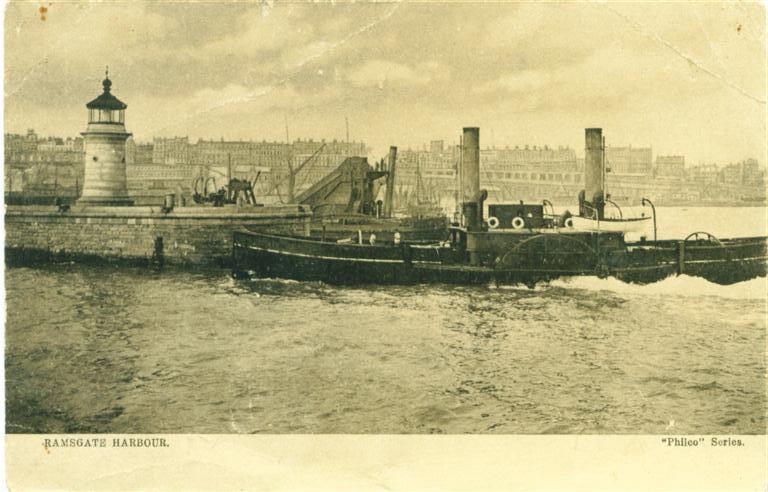
This is Ramsgate tug Aid 1 1865-1891
Aid [1] Built 1855 by Money Wigram & Sons, Blackwall. Wood paddle tug. L89.2'. B18'. D8.9'. 112grt. 50nhp 2cyl compound steam engine by John Stewart, Blackwall. ON24691.
1855 Delivered to The Royal Harbour of Ramsgate Trust, London. 1865 Owners The Board of Trade, London. 1890 Sold to John W Spicer & others, Wapping, London. 1891 Sold to James T Morgan & others, London. 1899 Owners The Shipowners' Tug Co Ltd, London. 1900 Sold to Dutch owners.
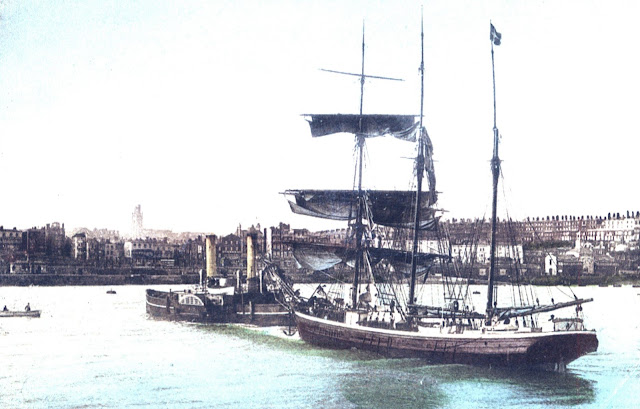
This is Ramsgate tug Aid 2, not the tall ship but the tug with two funnels, possibly 1890-1914
Aid [2] Built by W. Allsup & sons of Preston she arrived at Ramsgate in 1890 and was a 120 h.p. twin-funnelled paddle tug of 194 tons,
She worked from Ramsgate until July 1914; was put up for sale, eventually being bought by the Admiralty in July 1915 and transferred to Dover. She was sold by the Navy in 1919 in Constantinople ??

Aid, [3] built 1914 by Bow, McLachlan and Co., Paisley. Yard number 313.
90ftx18ftx9ft, 500 hp.
September 1914 delivered to Ramsgate Harbour Trustees.
1921, owners Ministry of transport, London.
1934, owners Borough of Ramsgate.
1937, owners Risdon Beazley.
28.8.1939, requisitioned by Royal Navy.
June 1940, at Dunkirk.
29.11.1940, sunk by German destroyer 7 miles off Start Point, 5 crew lost.


This would have been a better post, but much of the internet part of the research was on online forums and these have been decimated by Photobucket suddenly charging for third party image hosting.
This means that the majority of the pictures on the history forums have gone and been replaced by a message from Photobucket telling the the person who put the image there they have to pay money to Photobucket.
Here are the photos of the books that went out in the
bookshop today http://michaelsbookshop.blogspot.co.uk/2017/09/pigeon-wars-in-bookshop.html


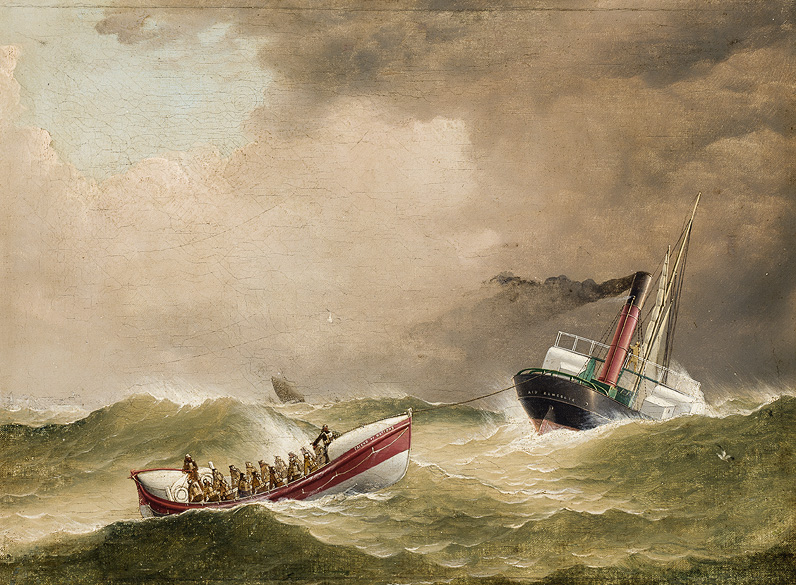
 I used a picture of Aid for the front cover of Memorials of the Goodwin Sands it shows the Ramsgate lifeboat being towed out of the harbour by the steam tug “Aid” at about the time the book was first published. This was the second (the only one with two funnels) of the three tugs named Aid that served Ramsgate harbour, the first from 1885 to 1889, the second from 1890 to 1914, and the third from 1914 to 1938. By 1938 Ramsgate lifeboat had its own engine and so didn’t need towing. The lifeboat in the picture (probably “The Bradford”) is of the self-righting type, the raised parts at each end being the buoyancy boxes filled with cork. A combination of these boxes and a weighted iron keel underneath meant that when the boat was turned upside down, by huge waves it rolled back the right way up. For a time my brother owned one of this type of lifeboat that had had an engine fitted and converted into a “pleasure” craft. Although it was evidently a very seaworthy vessel it was incredibly boisterous in any sort of a sea. Definitely built for seafarers with stomachs of heroes. As it surged up and down the waves like a roller coaster car one was only too aware that the stern buoyancy box had been emptied of its cork to enable the engine to be installed. The Bradford was propelled by 12 oars, with I think 2 men to an oar, I can testify that a similar vessel with a forty horsepower engine is an unwieldy craft that feels under powered when one tries to manoeuvre it. From about 1845 Ramsgate had a steam tug and from about 1858 two steam tugs the other being the Vulcan. The combination of the tug and lifeboat proved to be the most effective method of sea rescue before lifeboats were powered by their own engines. One of the Ramsgate tugs was kept with her boiler alight and ready for action 24 hours a day. In Ramsgate today (after a gap of about a year when they were stopped for health and safety reasons) we hear the maroons fired when the lifeboat is called out; often to rescue people who have underestimated the hazard of the Goodwins.